The Fairness Burden: A Therapeutic Tool for Children of Divorce
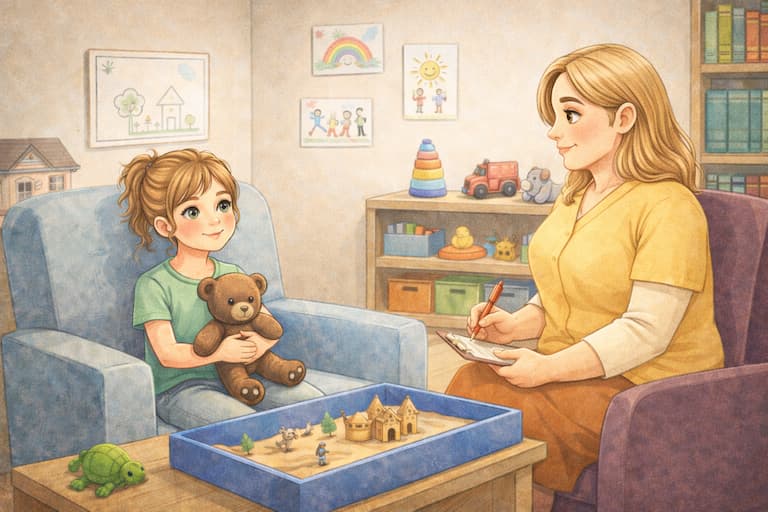
Imagine an eight-year-old I'll call Marcus, methodically explaining his system. He spent three hours at Dad's house last weekend, so this weekend he needs to spend exactly three hours at Mom's to "make it fair." Asked what would happen if he couldn't balance the equation, his face crumples. "Then Mom would think I don't love her as much."
Marcus isn't a real child. He's an illustration of a pattern, and I suspect you've met children like him. Marcus isn't managing a custody schedule; his parents are handling that. He's managing something far more exhausting: his own emotional accounting system, designed to prove he loves both parents equally.
Maybe your clients count hugs. Maybe they track which parent gets told the good news first. Maybe they keep a running tally of every activity, meal and bedtime story to maintain perfect equilibrium. If you work with children of divorce, you may already recognize this hypervigilance, and you may read it as the child's attempt to control the uncontrollable.
I wrote Olive and the Secret of the Pies, a children's picture book, to speak to this one pattern. It names the problem, offers a memorable reframe, and gives children permission to stop the work of emotional mathematics. This article describes how I think it can be used alongside your clinical work.
First, a word about who's writing. I'm a writer and a parent, not a therapist. What follows describes the book and the companion guide I wrote for it, along with the developmental ideas behind the metaphor. It isn't clinical guidance. You know your clients and your own training, and your judgment should lead.
The Belief Underneath the Counting
Divorce is hard on children, though most do well. A major meta-analysis found that, on average, children of divorced parents score somewhat lower than children of continuously married parents on measures of adjustment and well-being, but the differences are modest (Amato, 2001), and long-running research finds that the majority of children come through resilient (Hetherington & Kelly, 2002). You already address symptoms such as anxiety, hypervigilance and emotional dysregulation, validate feelings, teach coping skills and help families work through co-parenting.
Those interventions are crucial. But they may not touch one specific belief many children hold: that love is a finite resource that must be carefully rationed.
In the guide I call the broader pattern a loyalty bind: the feeling that closeness to one parent, or to a stepparent, is a betrayal of the other. Children in two-home families rarely say so out loud. It tends to show up as worry or withdrawal, as changes in behavior, or as distress around transitions. Olive's counting is a gentle version of the same pattern: she manages the bind by keeping everything equal.
I use the phrase "fairness burden" for how this looks in a child who takes it on alone. It can show up as:
- Counting and tracking: hugs, kisses, time spent, activities shared
- Emotional withholding: not sharing excitement about experiences at the other parent's home
- Schedule anxiety: distress about unequal custody arrangements
- Guilt: shame about enjoying time with one parent more than the other
- Self-imposed rules: internal regulations about what can be shared with whom
- Replication attempts: trying to recreate identical experiences across both households
Developmentally, this makes sense. Children in Piaget's concrete operational stage, roughly ages 7 to 11, can use logic to solve problems about the physical world but struggle with abstract concepts. They understand conservation (the amount of water doesn't change when it's poured into a different glass), reversibility and classification. Their thinking is systematic and logical, but about tangible things.
When you cut a pie in half, each person gets less pie. That's concrete, observable and true. A child thinking in concrete terms may naturally extend that logic: if I give Dad a big piece of my love, there's less left for Mom. That isn't faulty reasoning for their stage. It's concrete logic applied to an abstract idea, emotional capacity, that doesn't follow those rules.
Why Reassurance Alone May Fall Short
When we tell children "You can love both your parents," we're making an abstract claim that can clash with their concrete experience. They may know they love both parents. What worries them is whether they're showing that love equally. Telling them it's okay doesn't hand them a new way to understand how love works.
Reassurance, validation and psychoeducation remain essential. A new picture, one they can see and remember, can sit beside them. That's where I think the pies metaphor can help.
The Pies Metaphor: A Concrete Reframe
The book's central idea is that love is more like the special ingredient in a pie than like one pie to be split.
During a baking session with her grandparents, Olive discovers that love isn't like one pie that must be split down the middle. It's like the special ingredient in Grandma's pies: you can pour all of it into every pie you make, and it never runs out.
In one afternoon, Olive bakes five pies. The pie that takes longer to make doesn't contain more love. The pie she makes quickly isn't less loved. Each receives everything she has to give.
Why this may work for children at this stage:
- It's concrete. Children can picture pies and baking in a way they can't picture "emotional capacity." The metaphor operates in the concrete world they understand.
- It's experiential. Olive doesn't just hear the idea; she learns it by doing, which fits how children this age often learn.
- It shifts the picture from scarcity to abundance. The message isn't "stop counting," which addresses the behavior and not the belief. It's "love doesn't work the way you thought it did."
- It gives the child language. "I love you with a whole pie" is a phrase a child can use after the book is closed, and a clinician can return to when the worry resurfaces.
- It includes self-compassion. Grandpa's secret is that giving whole pies to others can fill you up, not empty you out, which speaks to the depletion a child may feel from the work of keeping things even.
I should be plain about what this is and isn't. The book is a picture book and a conversation tool. It hasn't been studied clinically, I'm not claiming it's an evidence-based intervention, and it isn't a substitute for therapy.
The Story's Therapeutic Elements
Beyond the central metaphor, a few features of the story may be useful in your work:
Third-party teachers. Grandma and Grandpa deliver the insights, not the parents. That removes any sense that one parent is angling for more love, or that the child must change to make a parent happy.
Discovery, not directive. Olive isn't told to stop counting. She discovers through her own experience that she can make many pies, each with all her love, which echoes guided discovery more than advice-giving.
A worry that's treated as caring. The story doesn't pathologize Olive's anxiety. Her worry is presented as understandable, even thoughtful. She isn't broken for feeling it.
Multiple applications. Making pies for her brother Joe, Aunt Sue and Uncle Bob shows that the metaphor reaches beyond divorced parents, which may be useful for children in blended families.
When It Fits, and When It Doesn't
The story works best when conflict between the homes is low. In the guide, I suggest thinking about the family's co-parenting pattern before recommending it:
| Co-parenting pattern | What it looks like | Using this book |
|---|---|---|
| Cooperative | Parents communicate easily and may share events or handoffs | A strong fit; both parents can read and reinforce it |
| Parallel | Contact is limited and businesslike, with little conflict | A good fit; each home can use the language independently |
| High-conflict | Parents are openly adversarial, and the child may be caught in the middle | Helpful as a supplement, but not enough on its own; referral recommended |
| Unsafe | A child's safety is in question | Not an appropriate primary tool; prioritize safety and appropriate intervention |
The Safety Limitation
This matters enough to repeat. The story presumes both parents are safe and loving. It offers no framework for a child whose parent is unkind, neglectful or frightening. Used in those situations, its message could inadvertently encourage a child to keep extending loyalty to a parent who harms them, reinforcing the idea that they must be selfless no matter how they are treated. Where there is any question of safety, the story's message of inclusive love has to be reframed so that the child's safety comes first.
Referring Onward
The guide suggests referring a family to a clinician experienced with stepfamilies and two-home systems when:
- Conflict between the homes is persistent and visibly affecting the child
- The child's stability rests mostly on one parent or household, and that parent is absorbing the tension of the whole system
- Treatment so far has used approaches designed for single-home families and hasn't accounted for the pressures of living between two homes
How You Might Use the Book in Practice
These are suggestions, not validated protocols. Adapt them to your clients and your approach.
In Individual Therapy
Assessment opportunity. Before introducing the book, you might ask: "Do you ever worry about keeping things fair between Mom and Dad?" Listen for:
- Counting or tracking behaviors
- Anxiety about unequal time or experiences
- Guilt about preferring one home's activities
- Restrictions on emotional expression
- Hypervigilance about parental reactions
If these are present, the fairness burden may be at work, and the book could be a useful next step.
Introduction. "I have a book I think might be helpful. It's about a girl named Olive who worries about something similar to what you've been telling me about."
Interactive reading. Read together at first, rather than assigning it as homework. Pause at key moments:
- When Olive cuts the cookie exactly in half: "Do you ever do things like this?"
- When she counts hugs and kisses: "What do you think about Olive's counting?"
- When Grandma explains the secret: "What do you think about that?"
- After she makes all the pies: "How do you think Olive feels now?"
Processing afterward.
- "What do you think about Grandma's secret? Do you think it could work for you?"
- "If you loved your mom with a whole pie and your dad with a whole pie, what would be different?"
- "What would it feel like to not have to count anymore?"
Ongoing. You can refer to the metaphor in later sessions: "How full is your love pie today?" or "Did you get to give anyone a whole pie this week?"
The guide includes more questions for children, including: "Do you sometimes feel like someone only deserves a small slice of your love?", "How comfortable do you feel talking to your parents about this?" and "What can grown-ups do so you don't have to keep things even?"
In Family Therapy
With both parents present (when appropriate and safe), reading the book in session can create a shared vocabulary. After reading, you might ask:
- "Parents, did you know [child] was working this hard to keep things fair?"
- "What do you want [child] to know about how you experience their love?"
- "How can we all help [child] feel safe loving everyone with whole pies?"
This can lead to moments where parents directly reassure the child that they don't need to keep score.
With one parent, use the book to help them understand what their child might be carrying. Many parents don't realize it. A parent can read it to the child, talk about what Olive learned, and say: "You don't have to keep things even for me. I know you love me."
As Bibliotherapy
You might say: "This week, I'd like you and [parent/caregiver] to read this book together. After you read it, talk about these questions…" and offer questions from the guide. Next session: "What did you think about Olive's story? Did you and [parent] talk about it? What did they say?"
Using the Metaphor with Other Approaches
With play therapy:
- Baking play: use play dough to "make pies" for different people
- Dollhouse: act out giving "whole pies" to family figures
- Art: draw or paint "love pies" for different people in the child's life
With CBT: the metaphor can serve as a replacement thought for worries such as these:
| Worry thought | Reframe using the pies metaphor |
|---|---|
| "If I have fun at Dad's, Mom will be sad" | "I can give Mom a whole pie AND give Dad a whole pie" |
| "I spent more time laughing with Dad, so I need to laugh more with Mom" | "Each pie gets all my love, not measured by time" |
| "If I tell Mom about the great day at Dad's, she'll think I don't love her" | "Sharing joy is giving a whole pie, not taking one away" |
With narrative therapy: you can externalize the problem as "The Fairness Worry" and ask: "When does the Fairness Worry show up most?", "What does it tell you that you have to do?" and "Now that you know about whole pies, how could you respond to the Fairness Worry?"
Possible Points to Introduce It
I don't know of research that identifies an ideal window, so treat these as judgment calls:
- Early after a separation, once the initial crisis has settled and children are making sense of the new structure
- Before a major transition, such as a parent remarrying, a new sibling or a change in custody
- When you notice fairness behaviors, rather than waiting for them to become entrenched
- Preventively, since the book can normalize the experience and give a child words for feelings they may not have words for yet
The Parent Layer
The book has two audiences. The story is aimed at children ages 6 to 8, in the read-to-me and read-along stages, so a parent is almost always in the room. Children see a girl learning that love doesn't have to be measured. Parents, if guided to look, can see a set of adult behaviors that either relieve a child of scorekeeping or quietly create it. In my experience, many parents need the message as much as their children, and they are often more receptive to it when it arrives through a picture book than as direct advice.
In the guide, I point out some of what the adult characters model:
- Scorekeeping can look like good behavior (pp. 7–9). Olive's counting shows up as sweetness: equal hugs, equal kisses, helpful chores. A parent receiving five kisses sees affection, not anxiety.
- Adults can hand children the job of fixing things (p. 5). When the cookies run out, Olive steps in to solve it. No one does anything wrong, but a child who fixes small unfairness learns to fix big ones.
- Time is not the same as love (p. 11). Grandpa's line speaks to both parents. The parent with less time may fear being loved less. The parent with more time may expect to be loved more. Both fears can reach the child.
- Supporting the child's love for the other parent (p. 24). Olive asks to take Dad his pie, and Mom says, "Of course." That may be the most important moment in the book for parents, and the easiest to read past.
- A healthy goodbye (p. 27). Dad says he will miss Olive, but he loves her with a whole pie. He names his own feeling without making Olive responsible for it.
Coaching Parents
If you coach parents, you might consider having each read the book alone before reading it with their child, and then discuss it with you. These questions work well in individual sessions:
- Which moment in the story felt most familiar to you?
- Has your child ever seemed to be keeping score? What might they be responding to?
- Which adult in the story would be hardest for you to be like?
- What would it take for you to say "Of course" the way Mom does on page 24?
- What do you say to your child at goodbyes? What might they hear in it?
- When you talk about the other home, are you using "parent brain" or "ex-partner brain"?
When both parents are willing, a joint discussion can help them agree on shared language, such as "whole pie" at handoffs.
Some parents are themselves depleted, and the metaphor can help them see that their child's love for the other parent doesn't diminish their love for them, that they can love their child with a whole pie even when tired, and that their child needs their whole love more than elaborate activities.
For parents, the guide offers a short practical list:
- Say: At handoffs, "Love your [parent/caregiver] with a whole pie!"
- Do: Create predictable handoff rituals, such as a "love pie" doodle in the backpack
- Avoid: Asking children to compare or report on the other home
- Model: Neutral, respectful language for the other parent
- Expand: Invite love for stepparents, grandparents and siblings. "We can bake more pies."
Beyond the Book
Once established, the pies idea can become a check-in language:
- "How full is your love pie today?"
- "Are you feeling loved by others today?"
- "How much love are you able to give today?"
That language can help children notice that their capacity to give varies (tired, stressed or sick can mean smaller pies), that receiving love helps fill them up, and when they're running low.
Self-compassion work: "What's a recipe for giving love to yourself?" extends the metaphor to self-care, since children can bake a pie for themselves.
Relationship exploration: "Who in your life gets whole pies right now?" and "Is there anyone you feel like only deserves a small slice?" The last question can be revealing. It can uncover legitimate safety concerns, unresolved anger, or places where the child needs support in navigating a complicated relationship. If it does, follow your usual clinical process.
Creative extensions:
- Art: pie illustrations for different people, colors for different "flavors" of love, a "love pie cookbook" of ways to show love
- Sensory/somatic work: what does a whole pie feel like in your body? What helps refill your pie?
- Play: toy kitchen play, puppet shows where characters learn to make whole pies, sand tray with pies for different relationships
School collaboration: with consent, sharing the "whole pie" language with a school counselor or teacher can create consistency and help the support team notice when fairness worry is emerging.
Where the Book Fits in Your Practice
The book tends to work best:
- When both homes are safe and loving
- As part of a broader therapeutic approach
- With therapeutic processing, not just independent reading
- When the fairness burden is actively present
- With parental involvement and support
If you'd like to try it:
- Get a copy of the book from Amazon or Barnes & Noble.
- Read the free companion guide (olive-pie.com/guide) before using it with clients.
- Consider where each family sits on the co-parenting spectrum above.
- Add a question about fairness worries to your standard divorce assessment, if that suits your approach.
- Share it with school counselors working with your clients.
Bulk ordering and custom printing, including co-branding and local-resource pages, are available for practices and organizations. Use the contact page to ask.
Conclusion: Permission to Stop Counting
The fairness burden is tiring. Children who carry it are working constantly, anxiously keeping perfect balance. They're doing it with love: trying to protect their parents, trying to be good children, trying to do the right thing.
What many of them need is permission to stop, and a picture that makes stopping feel safe. The pies metaphor is my attempt to give them that. It says: you can give all of your love to each person. You don't have to measure, count or keep score. Love doesn't work the way you thought it did, and that's good news.
I can't promise it will help every child, and I don't pretend it replaces the work you do. I hope it's a small, useful tool in the hands of people who do it well.
Book Details
- Title: Olive and the Secret of the Pies
- Author: Rob Arnold
- Target Age: 6–8 years old (read-to-me and read-along stages)
- Formats: Hardcover, paperback, and Kindle ebook (audiobook and other ebook formats coming soon)
- Where to Buy: Amazon and Barnes & Noble
- ISBNs: 979-8-9820466-0-4 (paperback), 979-8-9820466-1-1 (hardback), 979-8-9820466-2-8 (ebook), 979-8-9820466-3-5 (audiobook, coming soon)
- Library of Congress Control Number: 2026927841
- Companion Guide: Free at olive-pie.com/guide
- Contact: rob@olive-pie.com
Sources
Amato, P. R. (2001). Children of divorce in the 1990s: An update of the Amato and Keith (1991) meta-analysis. Journal of Family Psychology, 15(3), 355–370.
Hetherington, E. M., & Kelly, J. (2002). For Better or For Worse: Divorce Reconsidered. W. W. Norton.